An application sold under your mark
Desktop, mobile, an engineering tool, an on-prem client. If the name on the listing is yours, start from the assumption that it is a PDE.
Software
You do not need to ship a device to fall under CRA. An application, a library or an embedded system sold separately is a product with digital elements if you place it on the market under your name.
Book a call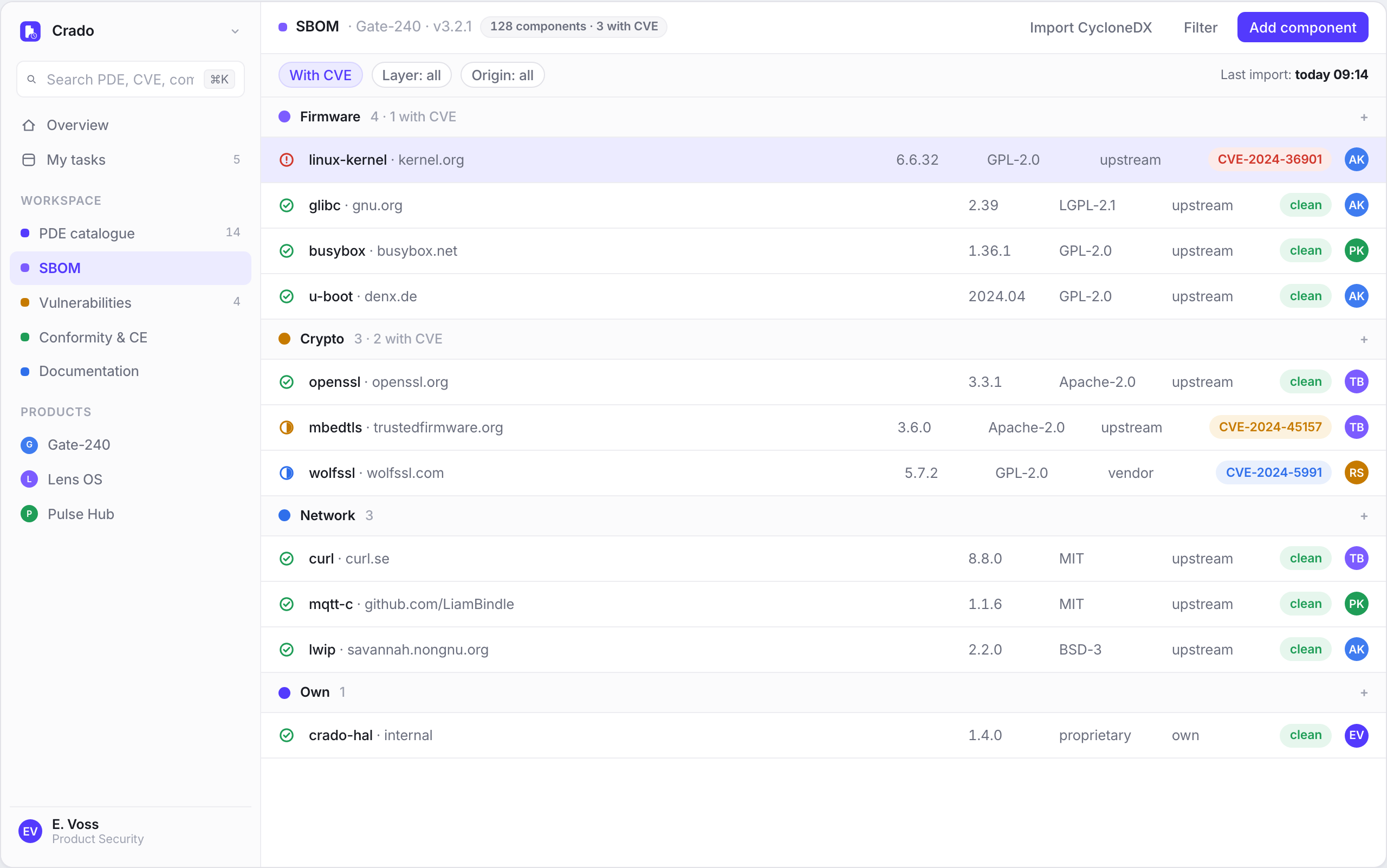
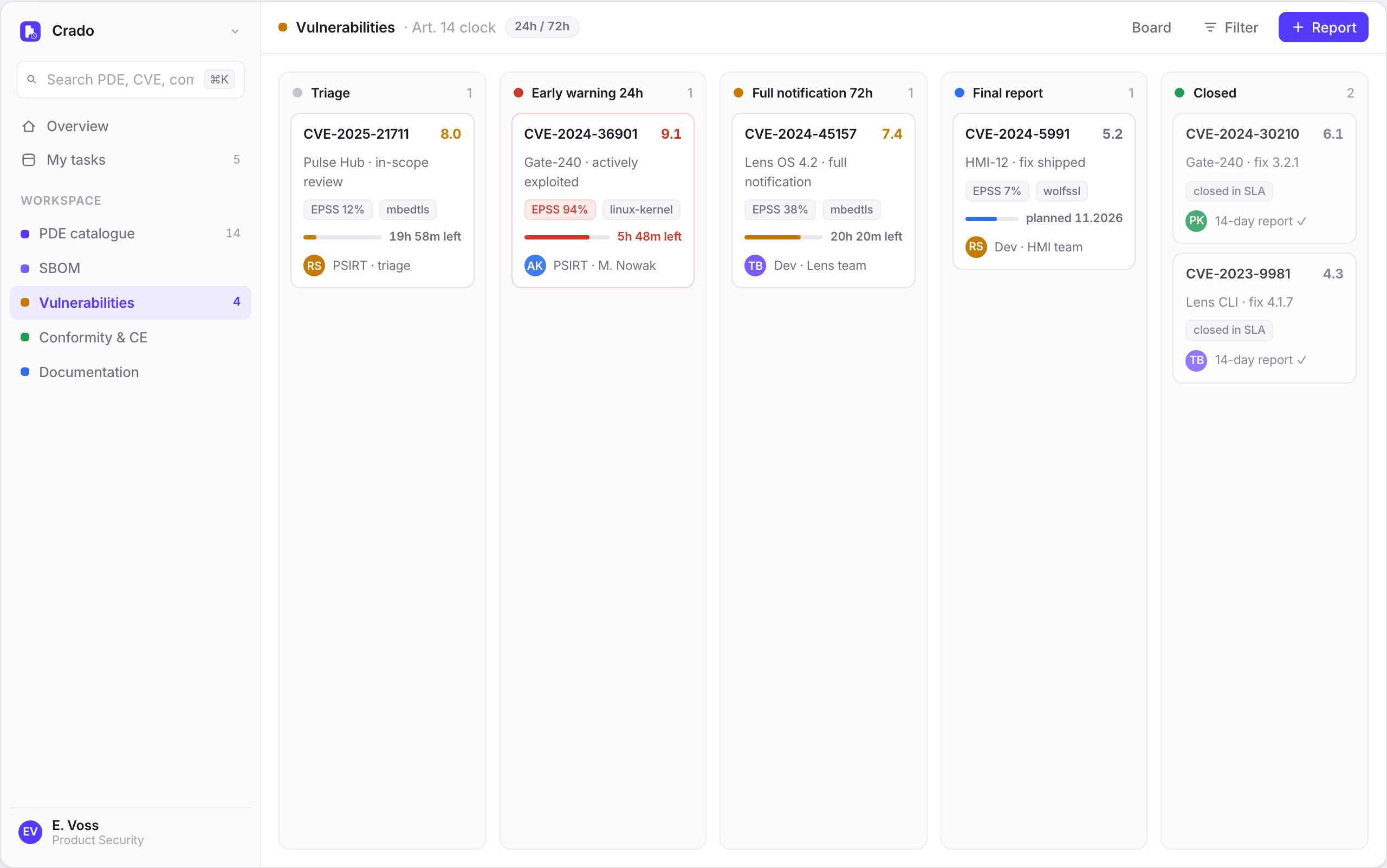
Regulation (EU) 2024/2847 does not ask whether you ship a box. It asks whether you place a product with digital elements on the Union market under your name or trademark. An application, a library, an SDK, embedded software sold separately - that is a PDE. The dates are the same as for hardware: Article 14 from 11 September 2026, essential requirements and CE from 11 December 2027.
A repository scanner does not replace a version catalogue, an Annex I risk assessment or an EU declaration. CRA applies to the product you place on the market, not “the company backlog” once. A substantial modification is a new placing: a new major version, a new digital function that changes the risk, a rebrand that makes you the manufacturer of record.
The file has to be assembled without moving source code off the network. Crado AI is on-premise for that reason: the SBOM, the CVE queue and the CE path stay with you.
Desktop, mobile, an engineering tool, an on-prem client. If the name on the listing is yours, start from the assumption that it is a PDE.
A component sold separately is its own product. Due diligence on dependencies stays with you even if the code is open source.
Firmware or a stack you license without a board does not leave scope just because “it is not a device”.
Scope is decided at placing on the market. If the same software goes to a customer under your mark, the catalogue needs a row.
01
Every release on the Union market has a row: name, version, markets, date, support end.
02
A build that does not match the SBOM does not ship. Third-party lines carry supplier and version.
03
A gap does not live next door in Jira. It points at the requirement it fails.
04
A named owner, a path to the single reporting platform, a drill on a production dependency.
CRA applies to a product with digital elements placed on the market. A pure cloud service is a different conversation. An on-prem client, an installer, a library or an app under your mark - start from a PDE and document why not, if you think it is not.
Not from due diligence if you place a product under your name and third-party components sit inside it. The SBOM and the assessment stay on the product you ship.
No. A substantial modification is. A new major version or a function that changes the cybersecurity risk gets a new row, a new SBOM and a new Annex I decision.
The SBOM and the technical file describe the composition of your code. They do not need to land on the CRA vendor’s server.
Connected devices, firmware and the support period.
Machines, controllers and automation with digital elements.
Electronics and hardware: technical file and CE mark.
Twenty minutes. How many products on the Union market, whether the SBOM comes from CI, who the manufacturer is in the contract.
Book a callInstalled on the customer infrastructure. Backups, identity and network stay in your standard. There is no SaaS plan.
Product