Manufacturer
The person who places the PDE on the market under their name. Primary addressee: design, risk, SBOM, support, documentation, CE, notifications.
Regulation (EU) 2024/2847
The Cyber Resilience Act is a horizontal framework for hardware and software made available on the Union market. The facts below come from the text, not from a law-firm memo.
The primary addressee is the manufacturer: the person who places a product with digital elements on the market under their name or trademark. Importers and distributors carry duties too. A product with digital elements is a device or standalone software, including components placed on the market separately.
The person who places the PDE on the market under their name. Primary addressee: design, risk, SBOM, support, documentation, CE, notifications.
Places a non-EU product on the Union market. Must check the manufacturer did their part and keep the file.
Makes the product available further down. Checks marking, instructions and whether CE is there at all.
May be appointed for authority contact. Does not take the risk assessment or Annex I off the manufacturer.
10 December 2024
The regulation is in force. Full application of the essential requirements comes later.
11 June 2026
The rules on notifying conformity-assessment bodies start to apply.
11 September 2026
Manufacturers notify actively exploited vulnerabilities and severe incidents: early warning in 24 hours, full notification in 72 hours, then a final report.
11 December 2027
A product placed on the market must meet Annex I, complete conformity assessment, carry an EU declaration and the CE mark. Risk assessment, documentation, SBOM and the support period must be maintained.
An appropriate level of cybersecurity for the risk. No known exploitable vulnerabilities at placing on the market. Secure defaults. Updates, including automatic ones with a clear opt-out. Access control, integrity, confidentiality, attack-surface reduction, data minimisation.
Identify and document vulnerabilities, including an SBOM. Patch during the support period. Tests. A public disclosure policy. Coordinated disclosure. Fixes without undue delay. Article 14 keeps a separate notification clock.
24h
Early warning from the moment you know of an actively exploited vulnerability or a severe incident.
72h
Full notification. One channel (SRP), to the CSIRT of the main establishment, and to ENISA.
14 days / 1 month
Final report: 14 days after a fix for a vulnerability, one month after the 72h notice for an incident.
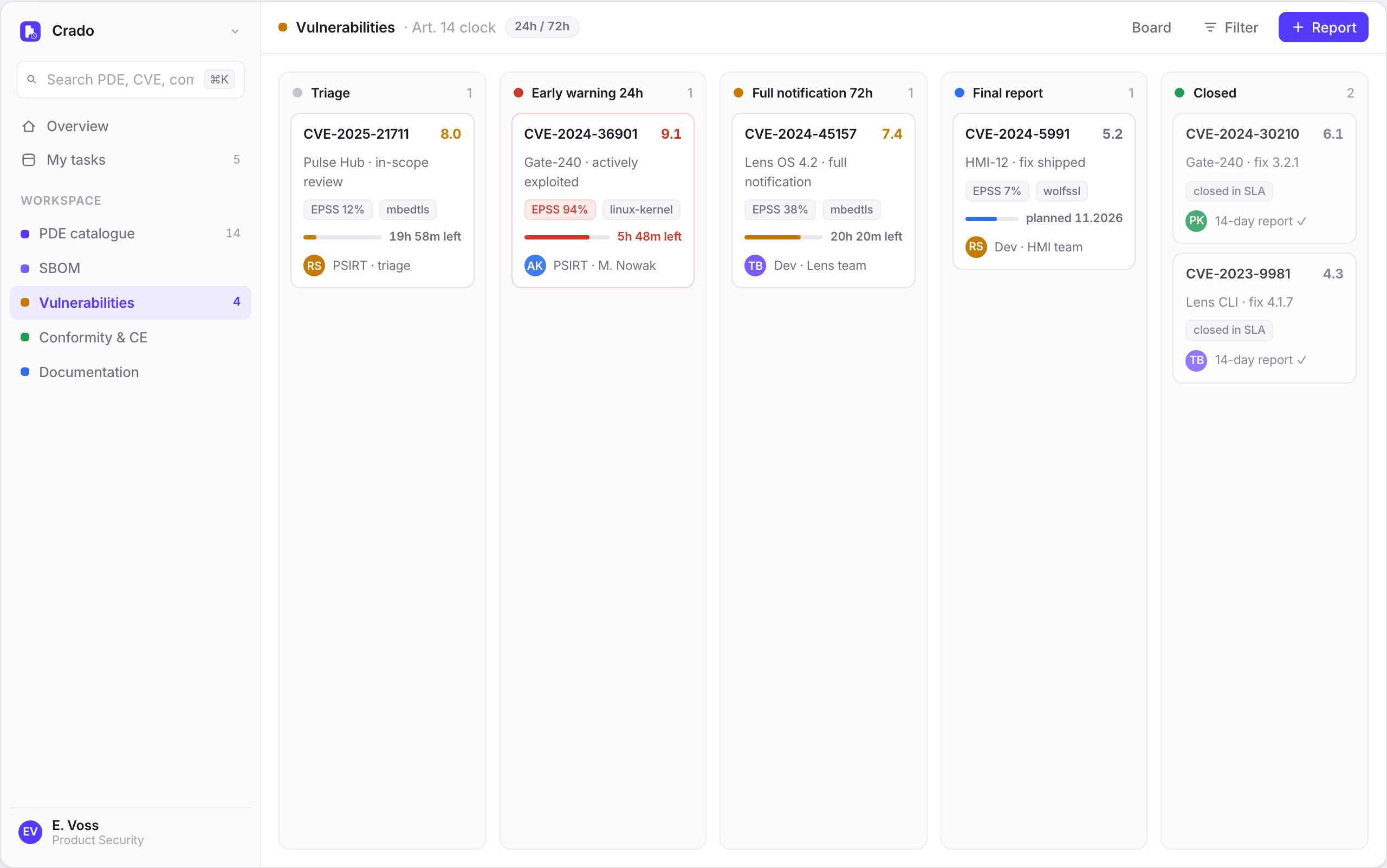
Source: Regulation (EU) 2024/2847 and the European Commission summary.
No. Vulnerabilities and the Article 14 clock are one module. The system runs the product map (PDE), risk assessment and Annex I, SBOM, the technical file and the CE path.
Yes, if you place it on the Union market under your name or trademark. A PDE is not only a box of electronics.
Article 14 applies: actively exploited vulnerabilities and severe incidents. Early warning in 24 hours, full notification in 72 hours, then a final report. Through the single platform to the CSIRT of the main establishment and to ENISA.
Annex I essential requirements, conformity assessment, EU declaration and CE mark when placing on the market. Risk assessment, SBOM, documentation and the support period must already be running.
No. You install Crado AI on your site. The SBOM and the technical file do not land on our server.
No. The system collects evidence and runs the process. Conformity assessment stays yours.
From a handful of SKUs to a catalogue in the hundreds. On the call we ask how many PDEs you have and whether an SBOM already comes from the pipeline.
A fictional catalogue (Gate-240, Lens OS). It shows interface density, not a customer.
To hello@crado.eu. We reply to the address you give.